SOC 2 Readiness Support for SaaS & Service Providers
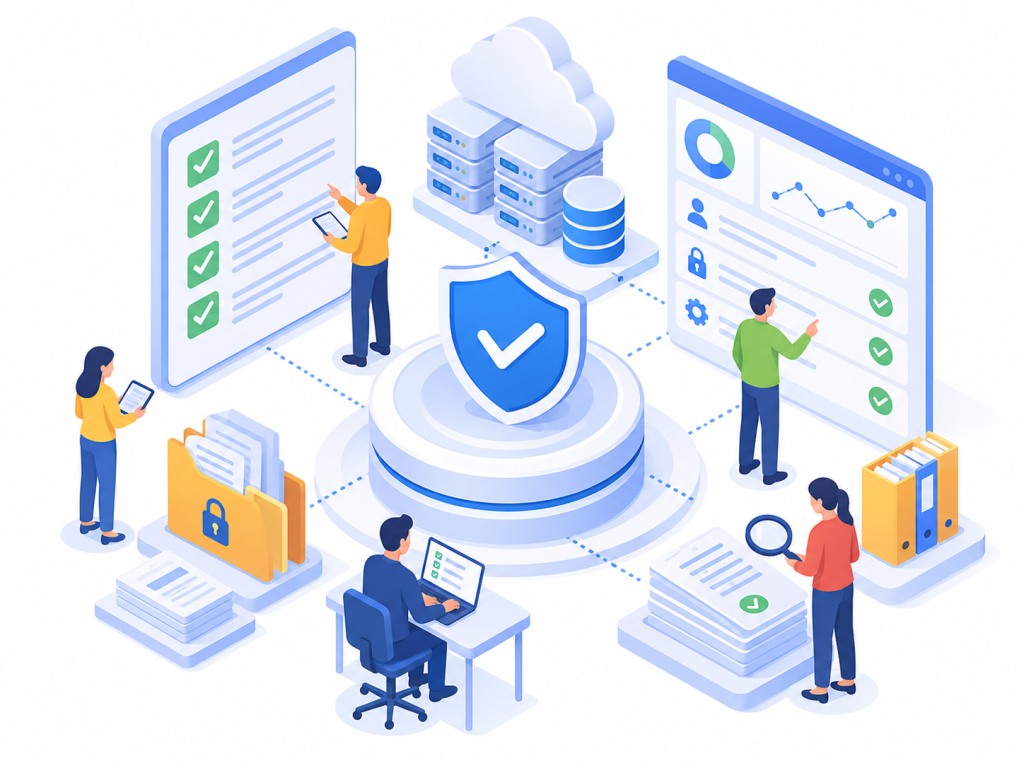
Customers, investors, and enterprise procurement teams keep asking for your SOC 2 report. We help SaaS companies, hosted-service providers, and tech businesses stand up the controls a SOC 2 audit examines — and operate them on the cadence the audit demands.
SOC 2 isn’t a certificate. It’s an attestation about how you actually run.
A SOC 2 report is an opinion issued by a licensed CPA firm about whether your controls — across security, availability, processing integrity, confidentiality, and privacy — were designed and (in a Type 2) operating effectively for a defined period. Customers ask for the report because it tells them how seriously you take their data.
The hard part isn’t the audit. The hard part is the year of work that gets you ready for it: scoping, control selection, implementation, documentation, evidence collection, and the day-to-day operation that makes a Type 2 actually pass. That’s what we do.
Who pursues SOC 2
If your customers handle sensitive data and you’re in their supply chain, sooner or later they’ll ask.
Hosted Services & Managed Platforms
Fintech & Payments
Healthtech & Patient-Data Platforms
Legal & Insurance Tech
Data & Analytics Providers
MSPs, MSSPs, and IT-Service Vendors
Education & Edtech
The trigger is usually external: an enterprise customer’s security
questionnaire requires it, an investor flags it during diligence, or a
partner won’t sign without one. By the time the request lands, the
runway is short.
Type 1 vs Type 2 — and the Trust Services Criteria
The shape of the report is determined by which TSCs you include and which type you pursue.
Type 1 vs Type 2
- Type 1 — examines whether controls are designed
appropriately as of a specific date. Faster to reach; useful as a first
milestone and as evidence in customer conversations. - Type 2 — examines whether controls operated
effectively over a period (typically 3–12 months). This is the
report most enterprise customers actually want.
Trust Services Criteria (TSC)
| TSC | What it covers | Required? |
|---|---|---|
| Security | Common Criteria — protection against unauthorized access (logical & physical). The SOC 2 baseline. | Always |
| Availability | System uptime and operational performance commitments. | Optional |
| Processing Integrity | System processing is complete, accurate, timely, and authorized. | Optional |
| Confidentiality | Information designated as confidential is protected as committed. | Optional |
| Privacy | Personal information is collected, used, retained, disclosed, and destroyed per the privacy notice. | Optional |
Your customers’ contracts and your service commitments drive which TSCs
to include. Most early SOC 2 reports cover Security plus one or two
others — typically Availability and Confidentiality.
How Technical Framework supports your SOC 2 readiness
Services map across the Common Criteria and the most-requested optional TSCs.
Scoping & Control Selection
Define the system in scope, choose the right TSCs for your customer
commitments, and select the controls you’ll be measured against —
without over-scoping and burning budget on controls no one is asking
for.
Gap Assessment
Map current state against the Common Criteria, document where the
gaps are, and produce a remediation plan with owners, dates, and cost.
Identity & Access Management
SSO enforcement, MFA across the environment, role-based access,
joiner-mover-leaver workflows, and quarterly access reviews — all with
the evidence trail an auditor will pull.
Endpoint & Production Security
EDR coverage, hardening baselines, patch SLAs, encryption at rest,
and the configuration management an auditor will look for in CC6.
Logging, Monitoring & Alerting
Centralized logging, alerting on the events the Common Criteria
expect, retention policies, and reviewable evidence of someone
actually watching the alerts.
Change Management
Documented SDLC controls, code review, environment separation,
change approval, and the ticket-and-pull-request paper trail an
auditor will trace end-to-end.
Vulnerability Management
Recurring scanning, prioritized remediation, patch SLAs, and
documented exceptions — controls auditors specifically test.
Incident Response & Tabletop Tests
Written IR plan, defined roles, communications paths, and at least
one tabletop exercise per period with documented findings and
improvements.
Backup, BCP & Disaster Recovery
For the Availability TSC: documented RPO/RTO, tested backups,
failover procedures, and BCP/DR plans the audit firm will want to
see exercised.
Vendor Risk Management
Third-party inventory, SOC 2 reports collected from your critical
vendors, periodic review, and the documentation of what you do when a
vendor’s report has exceptions.
Policies, Procedures & Training
The 12–18 policies a typical SOC 2 expects, an annual security
awareness program, role-based training, acceptable-use sign-off, and
the evidence to support every line item.
Evidence Library & Audit Liaison
A real, organized evidence repository — not a Slack channel. We
liaise with your CPA firm, respond to PBC requests, and reduce the
time your team spends in the audit instead of on the product.
Ongoing Managed Controls
The day-to-day operation that makes a Type 2 actually pass: monthly
evidence collection, quarterly access reviews, annual policy refresh,
recurring training, tabletop tests on cadence.
What we usually find on day one
- Scope is too broad. Companies sign up to be audited
against TSCs and systems they didn’t need to include — and pay for it
in audit hours and remediation. - Access reviews don’t exist. Quarterly user-access
reviews are a CC requirement and one of the most common audit findings. - SSO and MFA are partial. The main app has it; the
cloud admin consoles, the database, and the production-debug tooling do
not. - Change management is informal. Production deploys
happen, but there’s no consistent ticket-PR-approval-deploy paper trail
that survives an auditor’s sample test. - No tabletop exercises. The IR plan exists. No one
has ever practiced it. CC7 doesn’t accept that. - Vendor SOC 2 reports aren’t collected. The
auditor will ask for the SOC 2 reports of your top vendors. If you
don’t have them, they expect you to chase them down. - Evidence is scattered. Across Drive, Slack,
Notion, email, and three different ticketing systems. Auditors price
that in.
Why work with Technical Framework on SOC 2 readiness
We bring the same engineering rigor we use to run NIST 800-171 programs
for defense-supplier clients to SaaS and service-provider environments.
A SOC 2 program is a security program plus an evidence discipline; we
run both, so you don’t have to invent it from scratch.
Existing relationships with reputable, fixed-fee CPA firms — no
hourly-billing surprises during the audit.
Northern Colorado / Front Range presence with national engagement
experience: Fort Collins, Cheyenne, and remote.
One program, one team, one accountable point of contact — not three
different vendors handing you off.
Schedule a SOC 2 readiness call
A 30-minute conversation, no commitment. We’ll cover what your
customers are asking for, what TSCs you should include, and the
highest-impact gaps to close before you go to audit.
Technical Framework is an IT services company, not a CPA firm. SOC 2
reports are issued by licensed CPA firms performing attestation
engagements. Information on this page is general guidance, not legal,
audit, or compliance advice. Your specific obligations depend on the
services you provide, your customer contracts, and the TSCs you choose
to include — confirm with qualified counsel and a credentialed audit
firm.