HIPAA Compliance Support for Healthcare Practices in Northern Colorado
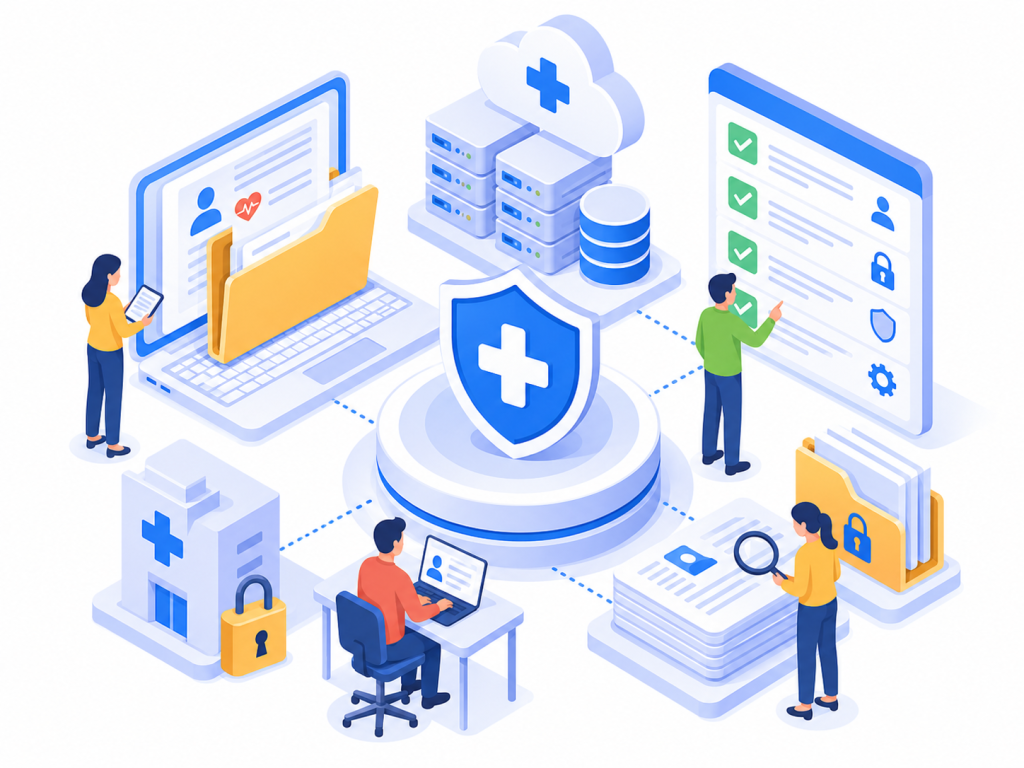
We help healthcare practices, Business Associates, and specialty clinics put reasonable safeguards around electronic protected health information (ePHI), document them clearly, and stay ready for audits, security questionnaires, and breach scenarios.
HIPAA isn’t a checkbox. It’s a program you maintain.
The HIPAA Security Rule, Privacy Rule, and Breach Notification Rule expect every Covered Entity and Business Associate to run an ongoing program — not pass a one-time test. The size of your practice, the complexity of your systems, and the kind of patient data you handle all shape what “reasonable and appropriate” looks like for you.
Technical Framework brings the technical, administrative, and documentation muscle most small and mid-size practices don’t have in-house. We help you put the safeguards in place, write down what you’re doing, and keep the program living.
Who we work with
If you handle patient data — directly or on behalf of someone who does — HIPAA applies.
Podiatry & Specialty Clinics
Behavioral Health
Dental Practices
Therapy & Counseling
Med Spas & Aesthetics
Imaging Centers
Business Associates (billing, EHR vendors, IT providers)
We work with practices throughout Fort Collins, Loveland, Greeley,
Cheyenne, and across the Front Range — both single-location offices and
multi-site groups.
How Technical Framework supports your HIPAA readiness
Our HIPAA-aligned services map to the Security Rule’s administrative, physical, and technical safeguards.
Risk Analysis & Gap Assessment
Document where ePHI lives, who can access it, and where current
controls fall short of HIPAA expectations. Output is a plain-English
report you can hand to leadership.
Technical Safeguards
Endpoint protection, full-disk encryption, MFA enforcement, role-based
access, audit logging, secure remote access, and patch management on the
endpoints that touch ePHI.
Network & Firewall Hardening
Network segmentation, firewall rule reviews, and intrusion monitoring
scoped to the systems handling patient data.
Email Security & Encryption
Secure messaging for ePHI, anti-phishing protections, mailbox
encryption, DMARC/SPF/DKIM hygiene, and configuration reviews of
Microsoft 365 / Google Workspace.
Backup & Recovery
Encrypted, monitored backups with documented recovery point and
recovery time targets — the foundation of HIPAA contingency planning.
Workforce Training
Security awareness training, phishing simulations, and role-based
modules that produce the records auditors expect to see.
Policy & Documentation
Written policies, system inventory, BAAs with downstream vendors,
sanction policies, and the audit trail that says “we did the work.”
Incident & Breach Response
Defined playbooks, on-call escalation, forensic preservation, and
support through the Breach Notification Rule’s investigation and
notification timelines.
Secure Disposal
NIST SP 800-88 aligned destruction of hard drives, SSDs, and printed
media with chain-of-custody and certificates of destruction on file.
The gaps we see most often in practices we onboard
- Risk analysis is missing or stale. Either it has
never been done, or it’s a generic template that doesn’t reflect the
actual environment. - BAAs aren’t tracked. Vendors with access to ePHI
either don’t have a Business Associate Agreement on file, or the
agreement is years out of date. - MFA is partial. Email is protected, but VPN, EHR,
remote desktop, or admin accounts aren’t — exactly where attackers go. - Backups aren’t tested. Backups run, but no one has
proven they restore. Ransomware exposes that fast. - Workforce training is inconsistent. New hires don’t
get it, returning employees don’t refresh it, and there’s no record. - Workstations aren’t separated from clinical systems.
Front-desk PCs, billing PCs, and clinical workstations share one flat
network. A compromise on one reaches the rest.
Schedule a HIPAA readiness consultation
A 30-minute conversation with our team — no commitment. We’ll walk through
your current state, the gaps that matter most, and what a defensible
HIPAA program looks like for your practice.
Technical Framework is an IT services company, not a law firm or qualified
HIPAA auditor. Information on this page is general guidance, not legal
advice. Your obligations under HIPAA depend on your role, size, and the
data you handle — work with qualified counsel for legal interpretation
and with a credentialed third party for any required attestations.